A redwood leaf, backlit by the sun, glows with light around its edges. Chlorophyll gives a green hue to the leaves, which capture sunlight so efficiently that redwoods are the fastest growing plant on the planet. Large redwoods add another 1,500 pounds of wood every year to their giant stature.
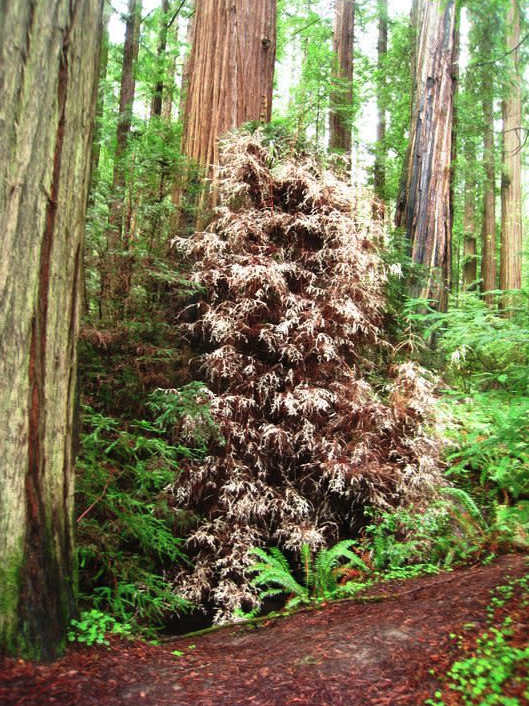
Some redwoods sprout white leaves, and a few redwoods are completely white. Albino Redwoods have little to no chlorophyll and are unable to photosynthesize, drawing food from their green counterparts. The green branches can provide food for itself and a white branch five times its size. Albino Redwoods were first thought to be non-lethal parasites. It turns out they are actually symbiotic to the green version and are an example of how adaptive redwoods are.
Albino Redwoods grow up to a few dozen feet high, unlike the redwoods that can grow up to three hundred and fifty feet high. There are less than four hundred known Albino Redwoods in the world, and there is a higher concentration of them in Santa Cruz and Sonoma where there is high UV light exposure and increased human activity. Scientists found that the albino lack of chorophyll was not physiological, but genetic, and that the white branches had two times the levels of heavy metals than their green counterparts. The green branches wouldn’t be able to tolerate such high photosynthesis-interfering toxicity—it would kill the tree. The white branches draw the heavy metals away from the green ones, becoming waste dumps, ensuring the green branches’ survival through their ability to make food out of sunlight.
Scientists mapped the redwood genome, a map of the complete set of DNA sequences that contains all of the instructions required for the redwood to function, including growth, responding to the environment, and resisting disease and predators. The information will help scientists restore and conserve the redwood ecosystem by learning these living giants adapt and ultimately inform restoration and management plans.
About ten thousand years ago humans began domesticating plants and animals. With the increase in starch in their diets, the human body developed the ability to digest it better with higher levels of salivary amylase gene, when combined with higher protein levels, improved digestion and buffered against intestinal disease.
It’s hypothesized that the redwood genome originated from a single ancestral species, alive over two hundred million years ago, continuing to genetically adapt to their environment. Their ancestry has provided gifts like learning how to capture water from fog during the dry summers. Their thick, tannin-rich bark resists fires. They regenerate through stump sprouting, helping them thrive after significant damage, which is unusual among conifers.
Time will tell if the albino branches will someday become more prevalent, and what else the redwoods will do to adapt. The redwoods teach us to be flexible, to change and evolve with our environment as one living being. The hope is that humans don’t ignore nature’s constant change and instead be part of that change by reducing our dependence on fossil fuels, for example, to reciprocate and protect the wonder around us.
Learn more:
https://education.nationalgeographic.org/resource/white-wonders


Leave a Reply