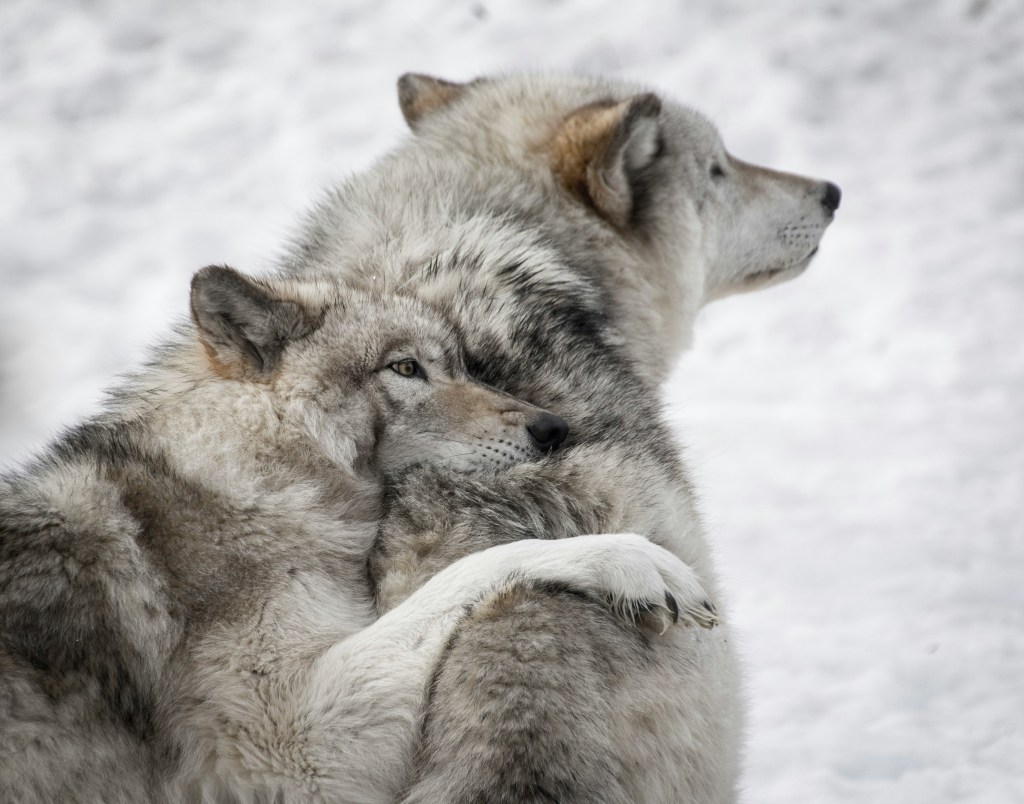
The two lone wolves travelled separately across the Sierra Nevada—she came from southwestern Oregon and he from northern California—and met by chance in a place uninhabited by wolves in a hundred years. It’s even more remarkable that the two decided to mate. The breeding pair are raising their six pups in three hundred square miles of the Sequoia National Forest.
Nearby, in Yellowstone National Park, the reintroduction of these apex predators is a rewilding story about a complex ecosystem intertwined with the wolves, their prey, vegetation, rivers, and humans. Wolves were introduced to reduce elk overgrazing of aspens and cottonwoods, which was affecting forest and river habitat. It was also hoped that the wolves would create a top-down cascade effect of the food web, for instance, slightly displacing coyotes that were overhunting rabbits and other smaller prey. The idea of rewilding is to restore a natural ecosystem to what it was before humans disturbed it. Defining how humans have disturbed nature over the last six million years is challenging. We can’t be sure what the ‘original’ ecosystem was, and it’s hard to pinpoint something which is always changing.
Misconceptions about wolves are many, for example, that wolves are dangerous to people. The fact is that over the past 200 years, in North America, two people have been killed by wolves. An average of forty people per year are killed by domestic dogs.
Wolves are similar to elephants, dolphins, and gorillas in that they live in family groups and take care of their sick and injured. They educate their young ones. Scientists debunked the idea of a dominant alpha male when it became clear there’s also a she-wolf leading the pack. A male and female supervise and attend to their family of pups, siblings, and non-related members.
Dogs were successfully domesticated, in part, because they responded to people’s eye contact. Wolves also have that ability, which made them on par with dogs in a test where a human was indicating which bin had food. What made wolves different was their ability to learn which bin had food without the help of human cues. Wolves are persistent, and it’s this quality that allows them to find food in the wild. Dogs have learned to rely on humans for food, whether they’re foraging garbage or getting dinner in their favorite bowl.
When wolves come across something new, they’re cautious, but not necessarily fearful. This goes back to their persistence. They’ll watch this strange, new thing. They’ll come closer and then back off. It could be food or something amusing that catches their attention. Wolves play their entire lives, having fun and strengthening bonds. Wolves playfully bow and dance with each other. They’ll chase each other. Without trying to hurt each other they’ll spar with open jaws, showing their teeth and growling.
The breeding male and female are mainly responsible for communicating boundaries and signalling dominance by marking territory. They’ll guide the pack’s hunting expeditions into a coordinated effort, sometimes lasting for days as the pack assesses terrain and looks for signs of weakness in the herd of elk, deer, or sheep. If they can herd their prey to a place where they have advantage, they will. Areas where the snow is crusty or icy, the wolves’ large paws act like snowshoes and keep them floating while a hoof will punch through, slowing down the animal. It’s better to tire out their prey, hopefully avoiding a life-threatening kick in the jaw or eye. The pups watch and learn as several of the adults attack. Hunts are rarely successful, and wolves may not eat for days. When they’re successful, the pack feasts. The breeding male and female eat first. If the she-wolf is back at the den with a new litter, one of the hunters will bring her food. An adult may eat as much as twenty pounds, and the next few days the pack takes it easy, resting and digesting.
The breeding female is the family glue. If she dies, the entire pack may dissolve, especially in a smaller pack.
The breeding male or female will kick off howling sessions. They’re warning other family members of danger, or showing off the size of the pack. The others will join in, with their distinctive voices, sometimes making the pack sound larger than it is, avoiding a fight with the neighbors. This territory is occupied. Each wolf’s unique voice allows wolves to identify each other. Because wolves have large territories—they’ll cover thirty miles in a day, or up to a hundred when prey is scarce. It’s easy to get separated, so they’ll howl to keep track of each other. Where are you? Where is everyone else? In open terrain, a wolf’s howl can carry ten miles.
It became legal to hunt wolves in Idaho, Wyoming, Montana, and Alaska, when those states removed the animal from their endangered species lists. In Idaho, there’s no limit to the amount of wolves you can hunt, as long as you have a license. An elk or deer license also suffices. Idaho’s wolf population dropped to about 1,100 wolves in 2025. State officials want to drop it to 500. Within these states you can also hunt with traps, a cruel death to any animal that falls into it.
In Daniel, Wyoming, Cody Roberts terrorized a young female wolf by chasing her with a snowmobile and running her over. It would have been legal to kill her that way, but Roberts wasn’t done with her. The wolf was still alive when Cody taped her mouth shut and paraded her at a bar. The bar clientele joined in, kissing and petting and taking photos with the scared, fatally injured wolf. After they had a good old time, Roberts dragged her outside and killed her. He was fined—$250. The fine wasn’t for assault. The crime, a petty offense, was possessing a live wolf.
Wolves were still protected in other states, until Trump signed an executive order to delist wolves completely in order to show ranchers what a pal he was, trying to distract them from beef tariffs and the cost of gasoline.
By regulating herd populations, especially elk, wolves reduce overgrazing and help regenerate trees and forests. Each wolf influences carbon sequestration of 6,080 metric tons annually, equivalent to six million pounds of coal burned or the annual emissions of 1,400 cars. Wolves act as filters to chronic wasting disease, a fatal neurodegenerative wildlife illness, because they can safely consume a sick animal and thereby reduce transmission between animals. There hasn’t been a record of a human contracting the disease from eating a diseased animal, but officials advise against it.
In Colorado, wolves have been reintroduced and ranchers are compensated generously for lost livestock, even though more livestock is killed in accidents and by vehicles than by wolves. Still, some wolves have been shot. Many ranchers have learned to live with the wolves and protect their livestock with guard dogs, electric fencing, and night corrals. These ranchers see far fewer losses than those who rely on killing wolves.
Whether we can solve humanity’s problems or global warming doesn’t depend on bringing species like wolves back from the brink of extinction, but that’s not why we should do it. We should do it because we’re inhabitants of this world, and we can be kind.
______
Further reading:
Jepson, Paul and Cain Blythe. Rewilding: The Radical New Science of Ecological Recovery. The MIT Press. 2022
Save the Redwoods: How New Wolves May Affect the Sequoia Ecosystem


Leave a Reply