The carbon exchange market was created with great intentions: save the forests, reduce pollution, and stop global warming. Many forest owners are earning more credit than their carbon offsets are worth, from 20-39 million extra credits, making the climate problem worse.
The world is watching how California manages its carbon market, with its goal to reduce carbon emissions. Forest owners, by improving the health of their forests, can obtain carbon credits and sell them to polluters who work towards reducing pollution over time.
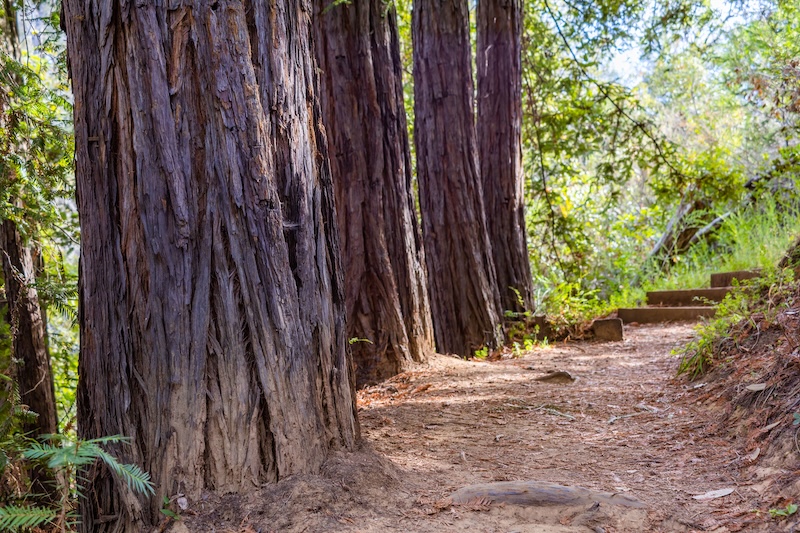
On the coast of northern California, redwoods and douglas firs rise to the sky, towering over three hundred feet when they reach a mature age and then grow outward becoming wider than a car. Their old-growth forests are a living world from the top with owls and murrelets to the middle with salamanders and centipedes to underground with their shallow roots entangled with fungal threads. These interconnected forests teeming with life are in danger because of their tremendous timber value. They also hold tremendous amounts of carbon, which make them players in the carbon credit market.
Old-growth coast redwood forests store more carbon per acre than any other forest, storing 890 metric tons of carbon per acre.
One passenger vehicle emits 1-5 metric tons of carbon dioxide every year
Forest landowners can earn carbon credits when they reduce logging or thin out shrubs and smaller trees to increase overall growth. Landowners can sell the credits to major polluters, mostly oil and gas companies, who have a plan to decrease pollution over time.
Forests are complicated, with different tree types and carbon storage amounts. The California Air Resources Board (CARB) created carbon estimates based on simplified, regional averages.
Landowners invite a third-party to estimate their true carbon storage. If the estimate is above CARB’s average for the region, the landowner can earn carbon credits by creating a management plan that protects the forest. The third party that verifies the carbon by mapping and measuring the trees also verifies forest management plans aswell as helps the landowner sell the carbon credits, earning a percentage per credit for their trouble. These verification companies are paid to create and sell credits.
Timber companies enroll forest plots that are at a lower risk of logging in the first place. Green Diamond Resource Company selectively chose areas with tanoak concentrations (not a timber species) and low amounts of redwood for their carbon credit forest management projects. This creates ghost credits, or credits that weren’t worth the carbon credit they receive, resulting in an overall carbon dioxide increase because it increased a polluter’s allowance. Green Diamond Resource Company doesn’t disclose what they’ve earned in total, but a couple of projects have earned 7 million credits, or an estimated $98 million.
Developers who initiate and lead the reforestation, maintenance, and carbon credit projects look for acreage that stand out above average on their carbon storage. In Northern California, there is a CARB boundary that separates the redwoods and douglas firs from an inland region that is quite similar. In the coastal region, CARB says the forests store an average of 205 tons of carbon per acre. On the other side of the line, the average is 122 tons per acre. Maintaining the forest with the higher carbon storage average can earn zero credits, and on the other side it could earn eighty credits per acre. For a 10,000-acre forest that could be the difference of $8 million. Landowners must show that it’s legally and financially feasible to log the area. In 2022 there were a dozen carbon credited projects in this zone.
A research study conducted by CarbonPlan studied sixty-five out of seventy-four projects and found that a majority of them were overcredited, while a few were undercredited.
Often these projects are on tribal land, because the land has been less aggressively logged than their neighbors so it starts with more carbon credits. The developers have helped tribes purchase land, create forest management plans, and secure tens of millions of dollars in credits. It is important that these tribes reclaim lands that were seized by the US government and its citizens, and it’s a legitimate interest to secure resources to purchase and protect those lands. By using offset credits as one of those resources, the purchase and protection of the forest is benefitting the forest, but not providing the overall carbon benefit to the earth as it was meant to.
“For us to use this as a means to allow corporations to continue to pollute,” said activist and member of Hoopla Valley Tribe Thomas Joseph, “goes against our cultural values. I see it as a second wave of colonization.”
It’s imperative that the carbon credit system gets an upgrade in order for it to be a solution to global warming, instead of increasing it.
________________
Save the Redwoods. Research from Save the Redwoods League and Humboldt State University Confirms Significant Role of Redwood Forests in California’s Climate Fight. https://www.savetheredwoods.org/newsroom/press-releases/research-confirms-significant-role-of-redwood-forests-in-californias-climate-fight/ April 30, 2020
Song, Lisa and James Temple. The Climate Solution Actually Adding Millions of Tons of CO2 into the Atmosphere. https://www.propublica.org/article/the-climate-solution-actually-adding-millions-of-tons-of-co2-into-the-atmosphere ProPublica/MIT Technology Review. April 29, 2021
Wheeler, Tom. Are Forest Carbon Projects Working? New Research Suggests Widespread Problems. https://www.wildcalifornia.org/post/are-forest-carbon-projects-working-new-research-suggests-widespread-problems. EPIC website. Mar 10, 2023


Leave a Reply