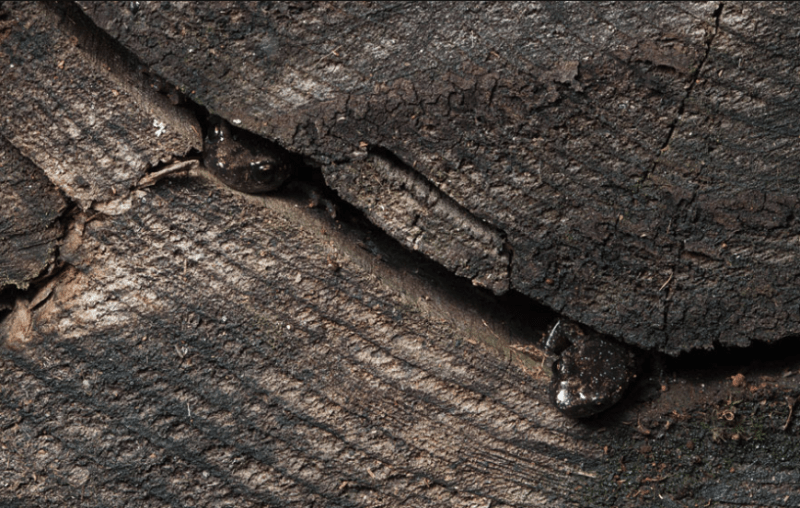
Photo by Spencer Riffle: Juvenile wandering salamanders in a crack
You could be in an alternate reality as a wandering salamander living in an ancient redwood tree. What would you tell people about the importance of your home, this endangered old growth ecosystem?
As this salamander, you’re living in a giant redwood tree’s fern mat, over 200 feet high, in the crook of a tree branch. Tasty mites and springtails are foraging in the same fern mat you live in, as well as other places on the tree. Your skin absorbs oxygen from the fog and rain. You’ve lived in this ancient tree your entire life, and so did your mama, memaw, and great granny. Everything you need is here, and “here” needs you too, keeping insects in check and decomposing food into soil. Gliding is instinctive, allowing for easy movement from an upper branch to a lower one to avoid a predatory bird or mammal or to look for springtails.
As a salamander, you have an immediate need for this forest’s health. If you could appeal to others to help protect your home, you would. Because if something happens to your home, you won’t survive.
For a person that’s miles away, like me, the importance of the ancient forest is less obvious. I’m not eating and sleeping there. It’s not my home. When we read about a fire or tornado in another state we feel sad and frustrated, but we carry on with our daily lives. We move on.
When many astronauts see Earth from space, they return home with the “overview effect”—they understand deeply that they share a common identity with all human beings. They feel unexpected and overwhelming emotion and an increased connection to other humans. I wonder if they feel that connection to all life on Earth. The idea of boundaries between “self” and the world dissolve as they consider themselves an integral part of the whole. Their perspective shifts, where politics and wars seem insignificant in the scheme of the entire cosmos. Some feel a religious spirituality. Many obtain more environmental awareness. Those of us who won’t be astronauts can still get this experience by visiting places on Earth like the ancient redwoods.
Earth is our home, regardless of politics, religion, or economic status. In this current social climate we tend to form strong group identities, often polarizing ourselves. There is so much common ground, like our love for nature, no matter how we appreciate it and enjoy it. This is a kinship, a community. Whether we’re sitting in the shade of a city tree, swimming in the ocean, or watching a bird fly, we are participating and being part of nature.
Sharing this passion, we can work collectively to protect forests, oceans, and mountains for all life, including ourselves. We can be advocates and do our part—small or large.
What can be your part, your contribution in this “nature community?” “Saving the world” can feel so overwhelming that we are frozen and don’t know where to start. It feels like there’s too many things, so one thing isn’t enough. I disagree. There’s so many things you can do, and picking one is better than picking none. I chose to learn and write. At the end of each blog I add different ideas for others to get involved. Some ideas will only take a minute out of your day, and others might be more time-consuming. Any and all of them will make a difference. All efforts, large or small, get us closer to making things better.
Even if we’re not the salamander, there are lots of reasons we should care about protecting the old growth redwoods. For starters: they are carbon sinks which keep CO2 out of the atmosphere, slowing global warming1; they contain worlds that are still unexplored and don’t exist anywhere else; they are beautiful and visiting them increases our well-being. These are just a few reasons.
The immediacy of need is stronger for the salamander that depends on the forest, but we too depend on these forests.
- Each giant redwood holds the same amount of carbon dioxide that 700 cars emit in a year.
What you can do
Help protect old growth redwood forests by making a donation to Save the Redwoods League. Their website is also full of great resources and stories.
Raise your voice: Call or email your representatives in Congress and leaders at the Department of the Interior to demand stronger protections for public lands. Your voice matters, whether you live within the redwood range or in any state in the nation.
Find your representatives or contact the Secretary of the Interior at (202) 208-3100 x 3.
References:
Camann, Michael A., Lamoncha, Karen L., and Clinton B. Jones. 2000. “Old-growth redwood forest canopy arthropod prey base for arboreal wandering salamanders: A report to Save-the-Redwoods League.” Humboldt State University. Arcata, CA. https://www.savetheredwoods.org/wp-content/uploads/pdf_camann.pdf
COSEWIC. 2014. “COSEWIC assessment and status report on the Wandering Salamander Aneides vagrans in Canada.” Committee on the Status of Endangered Wildlife in Canada. Ottawa. xi + 44 pp. https://www.registrelep-sararegistry.gc.ca/virtual_sara/files/cosewic/sr_Wandering%20Salamander_2014_e.pdf
Travers, M. 2024. “How ‘The Overview Effect’ Can Make You Feel Alive Again—By A Psychologist” Forbes.com. https://www.forbes.com/sites/traversmark/2024/07/24/how-the-overview-effect-can-make-you-feel-alive-again-by-a-psychologist/

 What the Ancient Forests are Telling Us
Leave a comment