Why We’re Transforming our Image of Nature as a Resource
Part 1
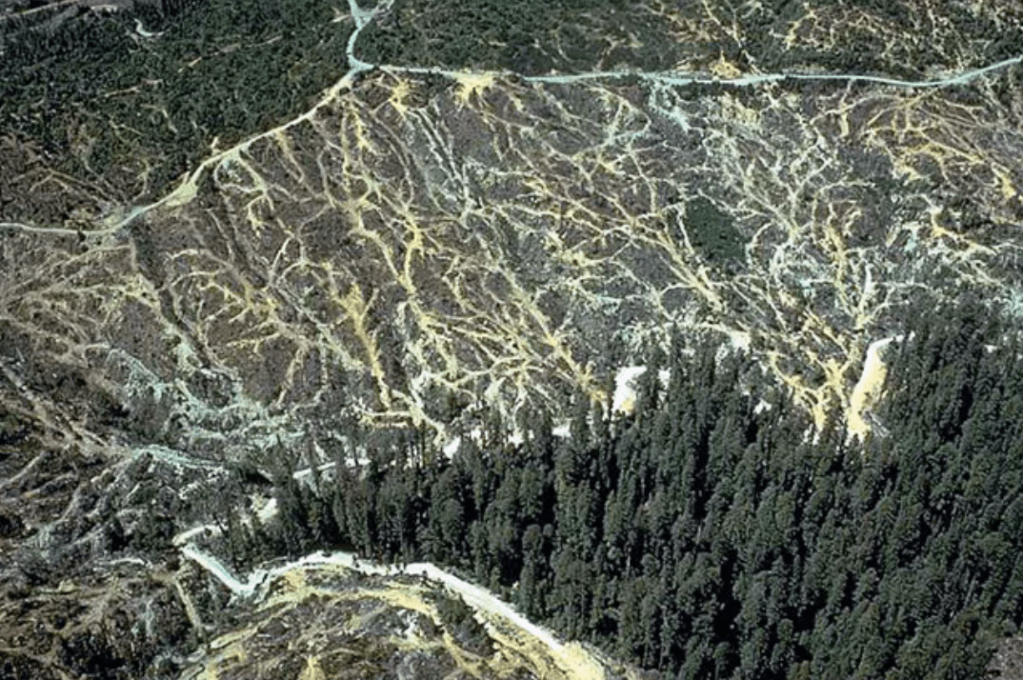
Photo: Logging and skid roads as seen along Bond Creek, Montana in the 1960s. National Park Service.
These forest roads I’ve four-wheeled, walked, and dirt-biked have provided experiences and memories that make me who I am. Many roads have brought my family, friends, and I, deep into the woods to camp with no other people for miles. Sometimes I felt guilty for all the noise we made, probably disturbing wildlife. At the same time I felt joy, met challenges, and had belly laughs as we appreciated the forest and people around us.
Many of these roads were originally built for logging companies. The Forest Service—started in 1905 by environmentalist and Republican President Theodore Roosevelt—constructed roads to give vacationers access to roam and enjoy the forest like he did. He also had protection in mind, and the roads gave Forest Service personnel access to fight wildfires and combat beetle-infestation.
By the 1950s timber companies helped the Forest Service build more roads to facilitate logging. These roads prioritized economy and efficiency without much concern for the trees and animals living there. Roadless areas are now scarce. In the contiguous U.S. it’s impossible to get farther than 22 miles from a road. These roadless areas are important habitats and sustain endangered species.
The abandoned logging roads are problematic in the Northern California old-growth redwood forest ecosystems. In 1996, seven families in Stafford woke up to a mudslide and barely left their homes in time before the wall of rocks, broken trees, and mud plummeted into their homes. The slide was a result of a forest road and clear cut area that couldn’t hold the rain and soil. This type of catastrophe still occurs within the redwood forests, damaging ecosystems of plants, salmon, and salamanders.
Some forestry practice is still based on the early European colonizer-style clear cutting, replanting trees in tidy rows, and spraying herbicide to reduce weeds. What indigenous people knew—and forest scientists are proving—is that these practices don’t really work as they damage the ability of the forest to regenerate properly. The tidy, homogenous rows of trees return less and less every crop. Many of the loggers see this happening but need the work. Logging companies are trying to stay in business by bringing high profits to their owners and shareholders.
The overuse of a finite resource is unsustainable for both the forest, loggers, and timber companies. The Oregon Forest Research Institute, a forest products association, claims clearcutting is practically a natural occurrence. This is from their website:
There are some similarities between a clearcut harvest and a forest opening caused by natural disturbances such as wildfires, windstorms, flooding and volcanic eruptions. Just like these natural occurrences, clearcuts create open space that many plants and animals need to flourish. Because a clearcut receives more sunlight, it creates optimal growing conditions for sun-loving shrubs, herbs and grasses that provide forage for animals such as deer and elk, as well as habitat for pollinators such as moths, butterflies and bees.
It’s a beautiful image, but it’s quite false. Clearcutting is comparable to a devastating wildfire that destroys everything in its path. Clearcutting causes erosion, landslides, and contamination of the water with sediment and the toxic herbicides used in the clearcutting process. Clearcutting also compacts the ground and decreases the soil’s ability to retain water, reducing the supply of clean water. It destroys wildlife habitat.
I thought that logging company’s practices of clearcutting had ended with the timber wars in the late 90’s, but I learned that California’s clearcutting actually increased in the early 2000’s and continues to this day. It is also the foundation of a recent presidential executive order and the Fix Our Forests Act moving its way through Congress, made under the guise of fire mitigation.
There is hope. Combining Western Science (WS) and Indigenous Knowledge (IK) is bringing new discoveries in practices that regenerate the forest for generations. Indigenous Peoples are collaborating with scientists to share their ancestors’ experience that predates the existing old-growth forests by tens of thousands of years.
Indigenous Peoples shaped the landscape, for example, by burning low intensity cultural and prescribed burns. This helps reduce the fuel causing our modern, intense, severely damaging wildfires. It also can improve the soil’s water holding capacity and nutrient flow to plants. Protection and restoration of old-growth forest ecosystems doesn’t mean we need to leave them completely alone, because we’re an important part of that ecosystem. This is reciprocity: receiving from the land and giving back to it, not just taking from it and then “fixing” it.
There are numerous examples of successful restoration. Redwoods Rising is a project combining Western Science and Indigenous Knowledge to remove old logging roads from 70,000 acres to rehabilitate and let the topography and hydrology restore itself. There’s also “mycorestoration”—using fungi to restore forest roads—which has helped renew soils, mitigate the effects of the herbicides used to reduce weeds, reduce erosion, and spur growth of native plants and animals. Mycologist Paul Stamets believes that we can’t keep drawing from the “ecological bank of the forestlands without returning nutrition back to the system.”
There are experts who believe we can successfully shift people’s jobs from clearcutting and instead to to careful harvesting combined with restoration and mitigation.
Instead of ignoring the effects clearcutting and road cutting will have on future generations, or believing that we need to reign over the Earth, I hope that we can restore our relationship with our environment. I’m not alone in wishing that my grandchildren’s grandchildren will enjoy the environmental, mental, and physical benefits brought by forests and all the life within them.
Tell the Forest Service that increased logging and clear-cutting old-growth forest isn’t how you want take care of the forests by filling out this form.
References:
Eisenberg, C; Prichard, S; Nelson, M.P.; Hessburg, P. 2024. “Braiding Indigenous and Western Knowledge for Climate-Adapted Forests: An Ecocultural State of Science Report.” https://depts.washington.edu/flame/mature_forests/pdfs/BraidingSweetgrassReport.pdf
Goldfarb, B. 2024. “The Case for Destroying Old Forest Roads.” “https://www.smithsonianmag.com/science-nature/case-destroying-old-forest-roads-180983693/
Oregon Forest Resources Institute. 2025. “When is clearcutting the right choice?”
Save the Redwoods. 2023. “Removing old logging roads in Redwood National and State Parks.” https://www.savetheredwoods.org/blog/video-removing-old-logging-roads-in-redwood-national-and-state-parks/
Stamets, P. 2003 “MycoRestoration of Abandoned Logging Roads.” Fungi Perfecti. https://fungi.com/blogs/articles/mycorestoration-of-abandoned-logging-roads

 What the Ancient Forests are Telling Us
Leave a comment