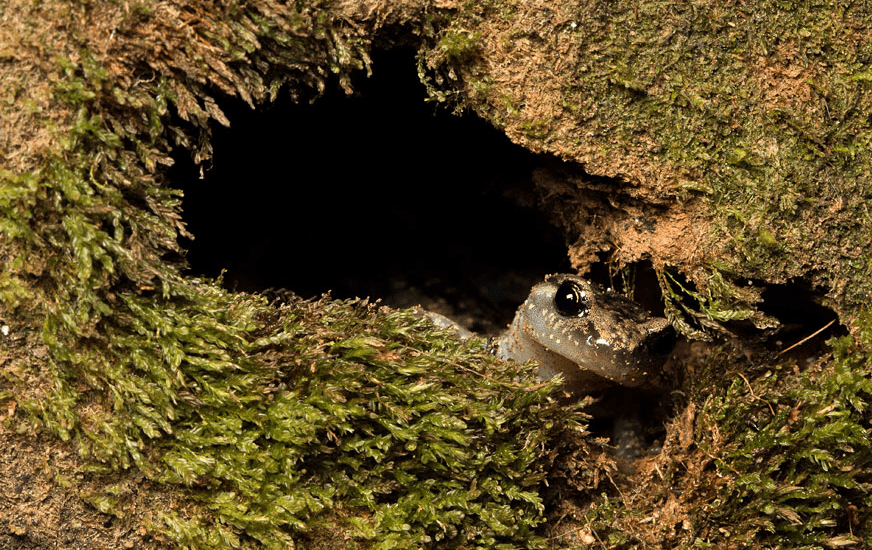
Photo by Spencer Riffle: Wandering Salamander at home in a Redwood Tree
Imagine a wandering salamander living in a 2,000 year old redwood tree. Many of its ancestors may have lived in this same tree. Generations can stay here because often there’s no reason to leave. While some wandering salamanders live in the forest soil, many live in fern mats, which grow in soil and duff that collect at large branch junctions in the canopy. The fern mat is like a sponge collecting water, and this moisture helps the salamander breathe. Being a lungless creature, the moisture on its skin helps dissolve oxygen and diffuse it into the bloodstream. There are other wandering salamanders living nearby in other fern mats, under bark, and in crevices in this giant tree. There’s a good supply of food—insects and arthropods—that also help decompose the dead leaves into soil.
This wandering salamander, Aneides vagrans, lives primarily in the canopy of old growth redwood trees, about 150 feet above the ground. These older growth trees, threatened by logging and drought from global warming, provide the habitat they need.
A light tap on the branch or a shadow passing over is enough for it to react and jump off the tree, immediately splaying front legs out and using feet and tail to maneuver, gliding and parachuting to a safe branch just below.
Gliding and Flying
With its relatively large feet, square toes, and tail it flies. It doesn’t have “wings”—or skin flaps between its front and back feet—like a flying squirrel. They don’t have physical characteristics that really set them apart from non-flying salamanders.
Christian Brown realized wandering salamanders could glide. “While they’re parachuting, they have an exquisite amount of maneuverable control,” said Brown, a doctoral candidate at the University of South Florida (USF) in Tampa. “They are able to turn. They are able to flip themselves over if they go upside down. They’re able to maintain that skydiving posture and kind of pump their tail up and down to make horizontal maneuvers. The level of control is just impressive.”
Save the Redwoods League is working to protect the wandering salamander’s habitat, which is shared by hundreds of other species of animals and plants that depend on the older trees. Donations of any size make a big difference! Click here to donate.
References:
Cal Poly Humboldt News. March 11, 2024. “Research Reveals how to Reinvigorate Canopy Biodiversity in Regenerating Redwood Forests” https://now.humboldt.edu/news/research-reveals-how-reinvigorate-canopy-biodiversity-regenerating-redwood-forests
Camann, Michael A., Lamoncha, Karen L., and Clinton B. Jones. 2000. “Old-growth redwood forest canopy arthropod prey base for arboreal wandering salamanders: A report to Save-the-Redwoods League.” Humboldt State University. Arcata, CA. https://www.savetheredwoods.org/wp-content/uploads/pdf_camann.pdf
COSEWIC. 2014. “COSEWIC assessment and status report on the Wandering Salamander Aneides vagrans in Canada.” Committee on the Status of Endangered Wildlife in Canada. Ottawa. xi + 44 pp. https://www.registrelep-sararegistry.gc.ca/virtual_sara/files/cosewic/sr_Wandering%20Salamander_2014_e.pdf
Reuell, P. January 31, 2019. “Study shows lungless salamanders’ skin expresses protein crucial for lung function.” The Harvard Gazette. https://news.harvard.edu/gazette/story/2019/01/lungless-salamanders-skin-expresses-protein-crucial-for-lung-function/#
Sanders, R. 2022. “Skydiving salamanders live in world’s tallest trees.” University of California
Cal Poly Humboldt. March 11, 2024. “Research Reveals how to Reinvigorate Canopy Biodiversity in Regenerating Redwood Forests” https://now.humboldt.edu/news/research-reveals-how-reinvigorate-canopy-biodiversity-regenerating-redwood-forests

 What the Ancient Forests are Telling Us
Leave a comment