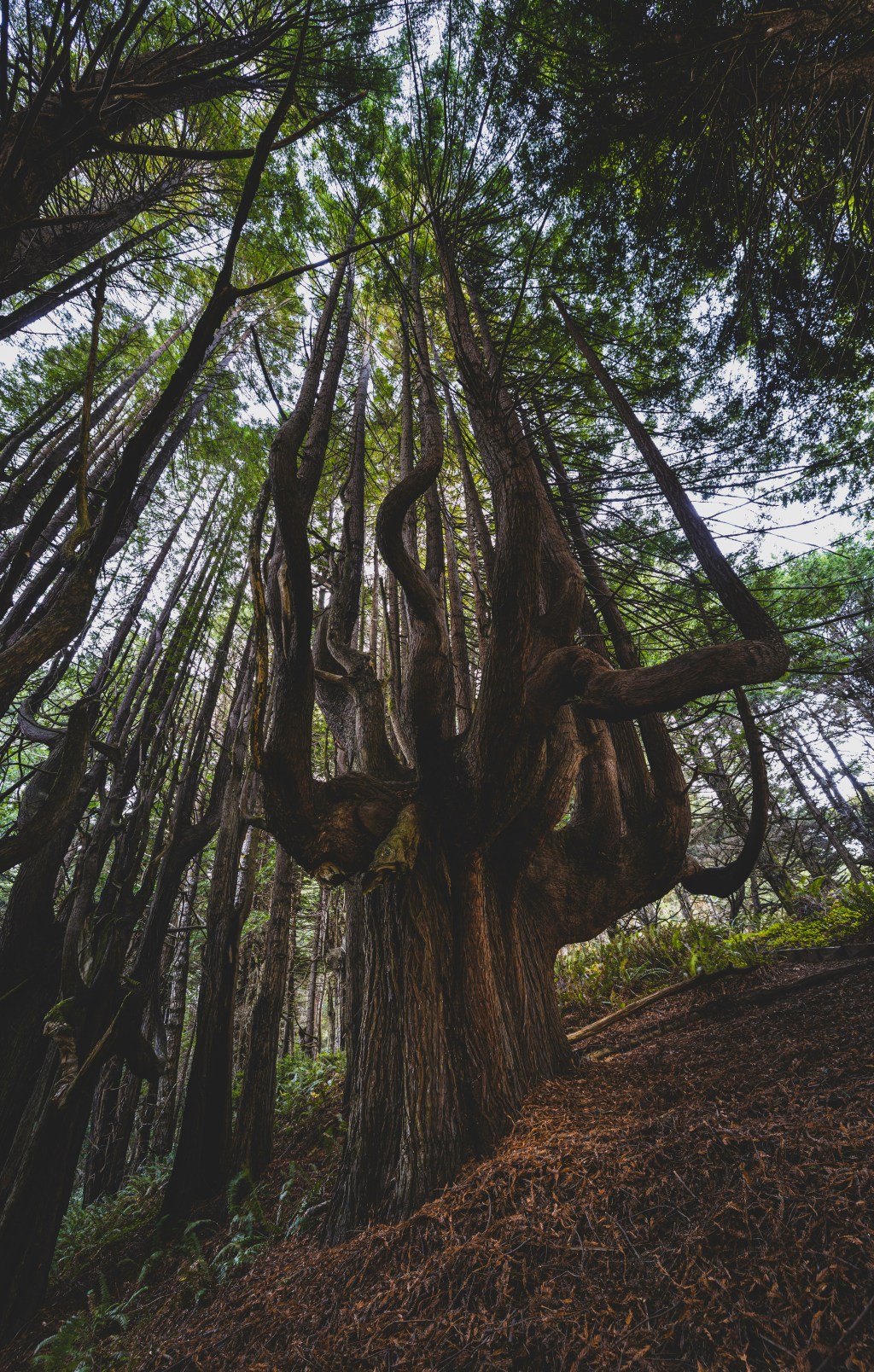
Photo by Clint McKoy
The ancient redwood’s influence has no boundaries as it reaches the lives around it. Although redwood trees don’t have a brain, they show problem-solving behavior.
The forest air reaches my sense of smell with a woody-earthy scent. Redwood trees release chemicals through little pockets between leaf cells and through their roots, sending signals that ripple throughout the forest. Most of the air’s molecules go further into my bloodstream filling me with monoterpenes and phytoncides. Monoterpenes have antioxidant and anticancer essential oils and phytoncides have antibacterial and antifungal properties. Researchers of “wood air bathing” found that when people walk through the forest, their blood pressure lowers. Diabetic patients’ blood sugar lowers to healthier levels.
As the tree breathes, it pulls in carbon dioxide and emits oxygen. As it pumps water through its roots to its leaves, it releases water vapor. It releases carbon through its roots.
The tree affects the world’s climate by reducing the CO2 in the air and storing carbon, truly the lungs of the earth. In 2019, the United Nations Intergovernmental Panel on Climate Change (IPCC) said that forest conservation and restoration plays a critical role in combating global warming. There can be up to 890 metric tons of carbon stored per acre of old-growth redwood forest, which is the estimated equivalent of taking about 700 passenger vehicles off the road for a year. The forests are an important source of carbon storage and reducing carbon dioxide in the air, but they can’t keep up with humans’ strong habit of burning fossil fuels.
Although trees and plants don’t have brains, they have intelligence by reacting to different situations differently. If a plant is wounded, it reacts in milliseconds, sending information to the rest of its body through electric signals at 6 centimeters per second. It emits different chemicals to ward off attacks and sends more carbon to its neighbors.
When insects chew on a plant’s leaves, the leaves react by flushing out toxins. These chemicals also travel through air and soil, dissolving into nearby plants which then turn on the same repellant as the plant being attacked.
Redwoods send underground signals through the mycorrhizal network, which provides a tree-to-tree network. This network is made up of tree roots and mycelium (microscopic fungal threads). The threads find their way to the tree roots and fuse with them. It’s a symbiotic relationship—the trees turn sunlight into food and share it with the fungal mycelium, and the fungi draw nutrients from the soil and share them with the trees.
When trees are under stress and lose their leaves, they send enzymes and extra sugar through the mycorrhizal network. Other trees, sometimes the same species and sometimes not, gain some of those extra resources and will then launch a defense.
It makes me wonder what happens when a redwood tree meets a chainsaw. Does it release warning signals to its neighbors? Do the neighbors try and help by sending more carbon or nutrients to the tree? It’s an extremely loud event. When The Dyerville Giant fell (as a result of a storm) a nearby resident heard a “deep roaring sound, followed by a boom that shook the house.” He thought the train had derailed on the train line below his house. Julia Hill Butterfly, the woman who lived in a redwood giant “Luna” for two years to save it, described the sound of a tree being logged: “It makes this horrible scream before crashing into those trees near it, breaking any branches in its way. It’s a bone-shattering sound all the way down, and then wham!, the ground shakes and the air hums, and everything vibrates with this fallen warrior.”
Maybe the mycorrhizal network is “hearing” a tree’s reaction, like a person exclaiming “WTF!” as the chainsaw makes its first cut. Then the mycorrhizal network that’s “heard” the reaction takes resources from the tree and sends them to other trees. It wouldn’t be a selfless act. The mycorrhizal network benefits, since it’s directly linked to the other trees and depends on them for survival, too. Or, maybe they’re all working together—the trees, fungi, air, bacteria—as a community because the whole ecosystem benefits when all thrive. David Read, who co-wrote the definitive textbook on mycorrhizal biology, suggested “that we should place less emphasis on competition between plants, and more on the distribution of resources within the community.”
These forests affect us whether we’re directly breathing them in or as they affect the world’s climate. As we share these resources, we too are participants in the forest ecosystem.
Our national parks are at risk. It only takes 5 minutes to send this letter to Congress to ask them to restore the jobs of scientists, educators, and caretakers of the forest.
References
Haskell, D.G. 2012. The Forest Unseen. Penguin Books.
Hinton, D. 2012 Hunger Mountain: Field Guide to Mind and Landscape. Shambhala Publications.
Li Q, Morimoto K, Nakadai A, Inagaki H, Katsumata M, Shimizu T, Hirata Y, Hirata K, Suzuki H, Miyazaki Y, Kagawa T, Koyama Y, Ohira T, Takayama N, Krensky AM, Kawada T. “Forest bathing enhances human natural killer activity and expression of anti-cancer proteins.” Int J Immunopathol Pharmacol. 2007 Apr-Jun;20(2 Suppl 2):3-8. doi: 10.1177/03946320070200S202. PMID: 17903349.
Maloof, J. 2006. “Breathe.” Conservation in Practice. https://www.uvm.edu/~jbrown7/envjournalism/Maloof.Breathe.pdf
Preston, R. 2007. The Wild Trees: A Story of Passion and Daring. Random House.
Sempervirens Fund. 2021. “Redwood Fairy Rings and the Magic of Science.” https://sempervirens.org/news/redwood-fairy-rings-and-the-magic-of-science/
Sheldrake, M. 2020. Entangled Life: How Fungi Make our Worlds, Change our Minds, & Shape our Futures. Random House.
Song, YY, S. Simard, A. Carroll, W. Mohn, & RS Zeng. 2015. “Defoliation of interior Douglas-fir elicits carbon transfer and stress signalling to ponderosa pine neighbors through ectomycorrhizal networks.” Nature.
“Unveiling the Hidden Senses of Plants.” 2024. https://www.youtube.com/watch?v=M6ujkIgqRWI

 What the Ancient Forests are Telling Us
Leave a comment