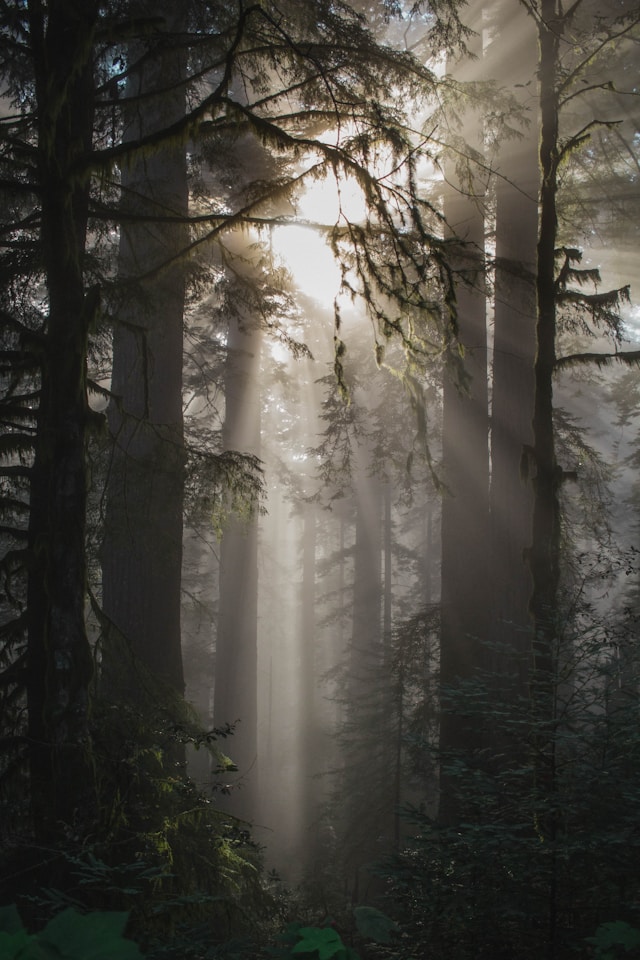
Jedediah Smith Redwoods State Park. Photo by Hannah Grace
This ancient redwood tree was a seedling when the world was ruled by Rome. The redwood’s ancestors mingled with dinosaurs. Now it stands over 300 feet tall and its trunk at the ground has a diameter the length of two cars.
This giant, a Sequoia sempervirens, has withstood fires and avoided chainsaws to finally retire within a national park. The tree’s large branches cradle huckleberry plants, fern mats, and Wandering Salamanders. The nocturnal Northern Spotted Owl nests in tree cavities and large branches and the Humboldt Flying Squirrel lives in lichen lined holes. Each of these animals in turn support the forest in different ways. The flying squirrels eat truffles and spread the spores. Salamanders eat insects and spiders and decompose them, contributing to soil.
There’s plenty of water so many creatures never leave this home high up in the tree. The water comes from rain, about 40-100 inches annually. Moisture also comes from the Pacific Ocean air that travels to the California coast and turns to fog, condensing on the redwood leaves and creating water droplets which the animals drink. Some of the water soaks into the redwood’s leaves, and some falls to the forest floor like rain. The forest creates its own climate, as well as the world’s climate by reducing the CO2 in the air and emitting oxygen. They are the lungs of the earth. These ancient forests store tons of carbon, tempering global warming.
Fungi live in the soil at the base of the tree, in the soil in the fern mats, under bark, and even inside the leaves. In the soil, the tree roots and fungus bind together to form a mycorrhizal network, the fungi providing nutrients in the soil in exchange for some of the tree’s sugary carbon. This network can run for kilometers and is possibly older than the oldest tree.
So much life. As I stand by this tree I suddenly feel anxious, like I’m an intruder, a polluter. I breathe in and out and feel my face relax. This forest outside of me wraps around me and welcomes me.
David Hinton wrote about the Chinese graph for sincerity which implies that if we are sincere, then our inner thoughts are the same as our outer thoughts. This is the fundamental structure of the Cosmos, where things are constantly changing, inside becoming outside, outside inside. This is the deepest form of belonging, and it extends to consciousness, “that mirrored opening in which a heron’s flight can become everything I am at the moment.”
The tree exhales as I inhale. The forest scents that surround me enter my lungs. Sounds flow through me like wind. My consciousness mirrors what I see and I am the forest.
Reference
Hinton, D. 2012. Hunger Mountain: Field Guide to Mind and Landscape. Shambhala Publications.

 What the Ancient Forests are Telling Us
Leave a comment