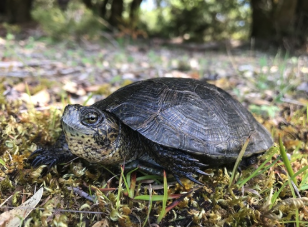
Photo: Western Pond Turtle. Credit: Justin Garwood, Naturalist.org
It’s early as my two dogs practice their first ritual of the morning, patrolling the backyard—looking for movement and smelling what has travelled through overnight. It’s May. It’s cold and there’s frost on the recently sprouted grass. Birds are proudly singing their songs, creating this morning’s symphony. With my lack of bird knowledge I can identify a robin, a dove, an owl. I hear a bird that sounds like an insistent alarm clock, while its neighbor sings something like “whoo-twee-tweet” and another sings “CHEESE burger, CHEESE burger.” I hear young coyotes far off to the right, and my dogs’ heads pop up looking in that direction. I call them and we come inside, leaving the birds and coyotes to their own rituals.
I am surrounded by a forest where I live. Most of it is privately owned with some public areas owned by the city or county. We have watched these parks close temporarily for fire mitigation, and when they reopen we slowly adjust to the changed landscape. There are plans and other information posted on websites, but we feel left out of the process and question its wisdom.
Many countries have created community forests (CFs), an option gaining momentum to conserve the environment, including old-growth redwood forests, while improving rural economies and recognizing the rights of locals to access the forest.
In Mexico, as a result of the early 1900’s Mexican Revolution, ownership of about 60% of the nation’s forests—104 million acres—came under the ownership of local communities. With government support and market incentives, locals have sustainably logged and maintained the health of the forest.
CFs in the US are differently owned and managed depending on how one defines a CF and where it is located. Many rely on timber production for some revenue. Most were created near towns or cities to prevent development and provide recreation. A recent inventory estimates over 400,000 acres of CF in the US, less than 1% of Mexico’s CF acreage and less than 1% of all forests in the US.
California coastal redwoods inhabit the near-800 acre Arcata Community Forest, by downtown Arcata. The first humans to live in the area were the Wiyots, who were pushed out by Europeans in the 1850’s. The area was clearcut and used for grazing and water supply. In 1955 it was dedicated as the first municipally-owned forest in California. The management plan focuses on watershed, recreation, and timber management.
Close by, Redwoods Rising is another restoration model, which is also focused on a healthy ecosystem and economy. Redwoods Rising has created ongoing opportunities for restorative economic activity that will continue for decades.
The plan is to rehabilitate 70,000 acres of previously logged forest and remove 300 miles of abandoned logging roads. The project is a collaboration of many: Save the Redwoods League, national and state parks, the Yurok tribe, CA Department of Fish and Wildlife, and people representing conservation, economic, and timber interests. The effort has brought an economic impact of $17 million between 2022-24 bringing investment and jobs to the region. Redwoods Rising has trained 70 apprentices, so far, in on-the-ground restoration who are continuing to pursue careers in natural resource science or management.
Some residents of Orick, a town close to the project, are upset with Redwoods Rising as they watch chainsaws fall and trim trees. Years prior, residents were banned from gathering firewood at the local beach. Some residents have also been jailed for poaching beautiful redwood burls, an act that damages and often kills the mighty redwood.
I do think that whether we agree with what’s being done or not, we might agree on the intent of restoring forests. Having any emotions about the issue—anger, frustration, hope—is part of the process. It’s actually encouraging. At the foundation of all these emotions is passion and concern. As humans are part of the world’s ecosystem, it’s important that we stay interested. It’s how we’ll stay connected to the forests and even find a call to action that feels true to ourselves and everything around us.
Learn more about Redwoods Rising here.
References
Bourgon, L. 2022. Tree Thieves, Crime and Survival in North America’s Woods. Little Brown Spark.
Bray, D. 2021. “Mexican communities manage their local forests, generating benefits for humans, trees and wildlife.” The Conversation. https://theconversation.com/mexican-communities-manage-their-local-forests-generating-benefits-for-humans-trees-and-wildlife-165647
City of Arcata. 2025. “Arcata Community Forest History.” https://www.cityofarcata.org/195/Arcata-Community-Forest-History
Redwoods Rising (National Park Service, California State Parks, Redwood Parks Conservancy, and Save the Redwoods League). 2025. “Assessing the Restoration Economy within Redwood National and State Parks—Socioeconomic Impact Study. https://www.savetheredwoods.org/wp-content/uploads/files/Report_Assessing-the-Restoration-Economy_RNSP_20250331.pdf
Hajjar, R. et al. 2024. “Characterizing Community Forests in the United States.” Journal of Forestry, Volume 122, 273–284. https://doi.org/10.1093/jofore/fvad054

 What the Ancient Forests are Telling Us
Leave a comment